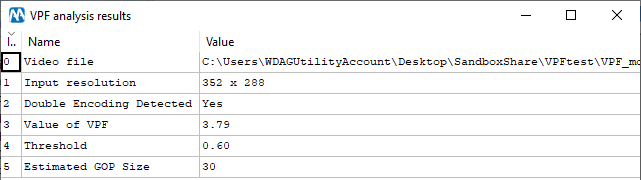
This article will focus on how to check video integrity by detecting double encoding with VPF analysis. It will start by defining video integrity and mentioning possible approaches to integrity verification. We’ll also make a very short introduction to some concepts of video coding. Then, we will show how you can use Amped Authenticate’s VPF analysis to reveal traces of double compression in videos. Additionally, we’ll show you how important this could be as a video integrity verification step.
When dealing with video evidence, integrity verification is a fundamental, yet often neglected, task. The definition of integrity can be summarized as: “the file is original and unaltered since the time of acquisition”. It’s plain and simple: the file should not undergo any change once it’s acquired. If it does, every change should be documented in the chain of custody. Notice that integrity is different than authenticity, which has a more “semantical” meaning. It requires the video to be an accurate representation of what it purports to be. If you re-compress a video, its authenticity will normally be preserved, but integrity is broken.
I know someone could think “the last thing I need is having to waste time checking one more thing in all my casework”. Understandable. At the same time, though, if one day I’ll be charged with something, I would really love to know that all the evidence pertaining to my case has been handled with the greatest care. I’m quite sure that holds for all readers of this article! If you’re in the forensic field, then you know that working with video is not just “common sense”. We’re not sorting our holiday pictures; we are handling evidence that could change somebody’s life, and dramatically so.
Let’s take a deep breath and dive in!
Read the full article here.