This blog post represents the Volume 2 in our series on Body Worn Cameras.
Let’s go through a thought experiment: we are a police officer about to enter into the pursuit of a suspect. Fortunately, in some cases we may not need to manually turn on our body worn cameras. That is because it has been programmed to do so upon sensing movement and other triggers. We begin running after the suspect. When we are close enough to the suspect we draw our service weapon and begin the process of arresting them.
Rolling Shutter Effect
Okay, how would this video look when viewed in court? First of all the video will be very shaky and due to the rolling shutter effect possibly distorted. “Rolling shutter is a method of image capture in which each frame of a video (in a video camera) is captured not by taking a snapshot of the entire scene at single instant in time but rather by scanning across the scene rapidly, either vertically or horizontally. In other words, not all parts of the image of the scene are recorded at exactly the same instant”

Barrel Distortion
Add to that the distortion (barrel distortion) from the wide angle lens and we end up with something most likely insufficient. In order for us to be able to use this footage, we need to analyze and enhance it. “In barrel distortion, image magnification decreases with distance from the optical axis. The apparent effect is that of an image which has been mapped around a sphere (or barrel). Fisheye lenses, which take hemispherical views, utilize this type of distortion as a way to map an infinitely wide object plane into a finite image area. In a zoom lens, barrel distortion appears in the middle of the lens’ focal length range and is worst at the wide-angle end of the range.”
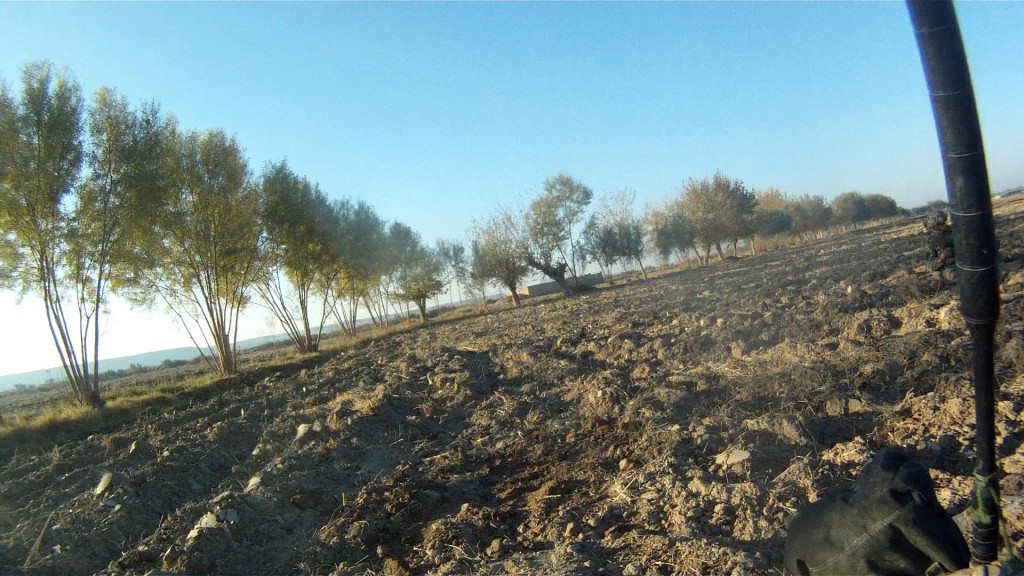

In order to use this footage, we would need to first select the appropriate frame range. Then, stabilize the area of interest, correct the lens distortion and possibly apply further filters to enhance other aspects such as noise reduction or contrast. Now we are in court presenting what is essentially an edited and enhanced video as evidence, a big problem. In order for our methods to be admissible in court, we need to follow the empirical method of study, workflow, analysis and reporting with scientific references. Something only our software Amped FIVE does.
Facial Distortion
There are also problems with distortion that software cannot currently fix. For example, facial distortion is related to the distance between the subject and the device. If the only frame of a subject’s face is when he is very close to the camera then it is possible that the resulting image will look markedly different from reality. This could result in an incorrect selection in a lineup. Or if the subject escapes, the resulting description might not be adequate.
Conclusion
After considering this, we can see that we are far from the silver bullet solution we are looking for. That is unless we take a different approach and incorporate empirical, scientific and algorithmic software to enhance and edit the source footage and allow for our actions to be reported on in such a way that makes it recordable and reproducible via the scientific method. Such a collaboration has begun with the key acquisition of Mediasolv by Taser and by software such as Amped FIVE. By tackling video evidence with this approach, we will be going a long way in the direction of providing a solution.
In the next volume, we will discuss the issues surrounding storage (cost, retrieval, cloud options and public access).